From simulation to certainty: how solar geometry and 4D animations are transforming energy projects
How solar geometry and 4D animations allow the analysis of solstices, equinoxes, and real shadows to design energy projects with certainty.
INGENIERÍA SOLAR
Ing. Alfredo Antonio T. Demetrio
2/5/20264 min read

Introduction: the sun is not an assumption
In many energy and architectural projects, the sun is treated as an “average” value: a typical height, a generic orientation, or a standard condition. The problem is that the sun is never average. Its position changes every hour, every day, and every season. Ignoring this movement leads to design errors, energy losses, unexpected shadows, and decisions that are difficult to correct on-site.
Today, thanks to advanced simulation and 4D solar animations, it is possible to move from intuition to technical certainty, visualizing and quantifying the actual behavior of the sun before building.
Solar movement: the physical basis of every project
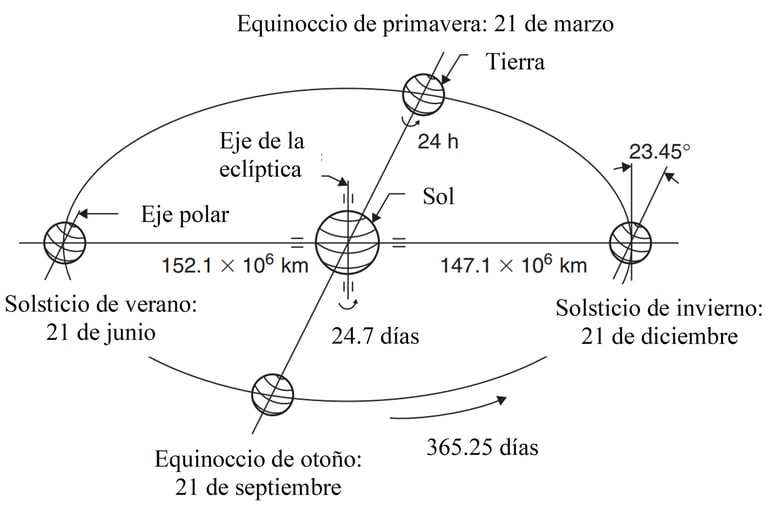
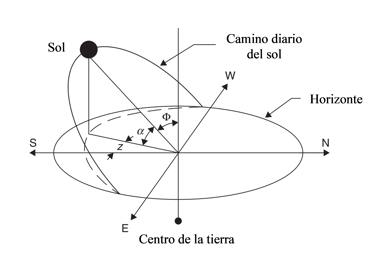
The apparent path of the sun is governed by well-defined astronomical phenomena: the tilt of the Earth's axis (23.45°), the Earth's annual revolution, and its daily rotation. From this interaction arise the solstices and equinoxes, key moments that determine the sun's altitude, the length of the day, and the direction of shadows.Comprender esta geometría no es teoría abstracta: es indispensable para calcular radiación incidente, definir la orientación de sistemas solares, evitar sombreado y diseñar estrategias bioclimáticas coherentes.
The equations that govern solar animations
4D solar animations are the direct visual representation of fundamental equations of solar geometry.
Declination (δ)
Declination describes the north-south position of the sun throughout the year:
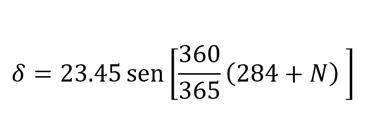
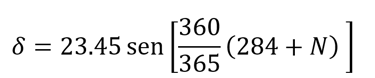
where N is the day of the year.
This equation explains why, in the animations, the sun reaches its maximum height at the summer solstice, crosses the celestial equator at the equinoxes, and remains low in winter.
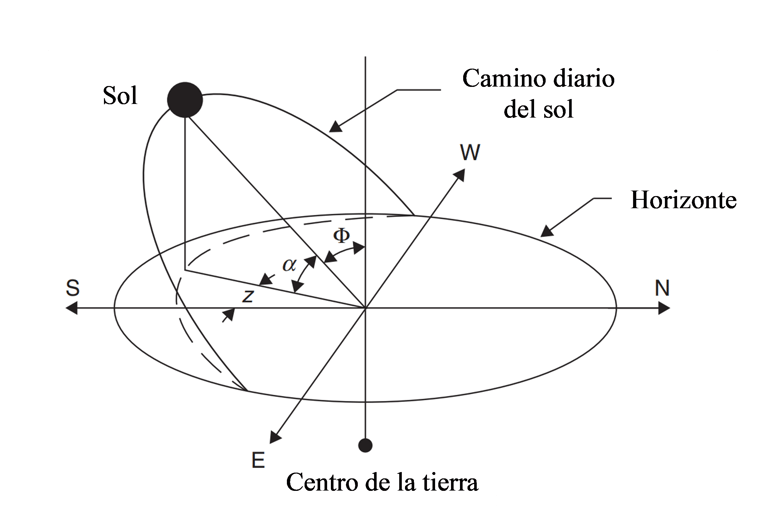
Solar altitude (α): the key to shadows
The sun's altitude determines the length and direction of shadows:
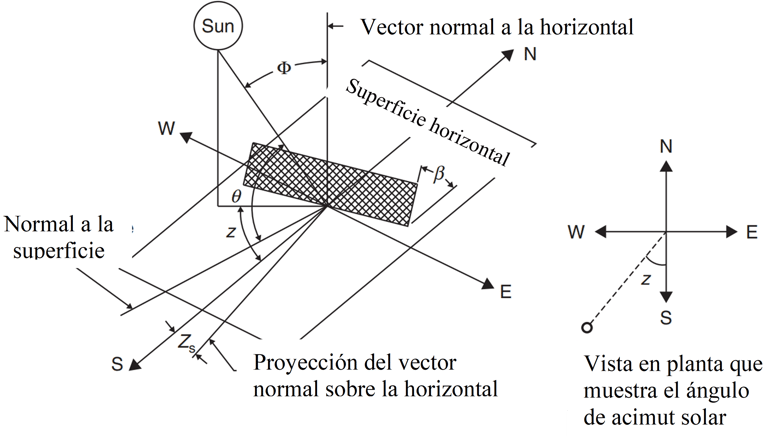
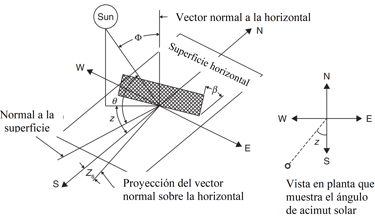


Every shadow that appears in a 4D animation (whether in June, March, or December) is a direct result of this trigonometric relationship.
Angle of incidence (θ) on surfaces
For south-facing inclined surfaces (typical case in solar systems and facades):


This angle defines how much energy a surface receives and whether a shadow will be critical or not.
Calculation of daily daylight hours
One of the most crucial, and often underestimated, factors in energy projects is the daily duration of solar radiation, that is, the hours of sunlight available throughout the year. These hours are not constant and depend directly on the latitude of the site and the solar declination, varying significantly between solstices and equinoxes.
The total duration of the day, expressed in hours, is obtained directly as:


At the equinoxes, when the solar declination is practically zero (δ ≈ 0°), the length of the day is close to 12 hours at any latitude. In contrast, during the solstices, the variation can be extreme: long days in summer and noticeably short days in winter, especially as latitude increases.
From equations to 4D model: the case of solar animations
The shared solar animation video shows sun shadows for the solstices and equinoxes of the year. Each scene represents:
A specific date of the year, characterized by a specific solar declination (δ).
The complete cycle of solar hours of the day, represented by the continuous variation of the hour angle (h) from sunrise to sunset.
The actual geometry of the environment, including orientation, slope, obstacles and physical context of the project.
What the observer perceives as an “animation” is, in reality, the continuous and dynamic graphical solution of the equations of solar geometry applied to a real three-dimensional environment. Every change in the sun's position, every shadow displacement, and every instant of illumination corresponds to a specific geometric condition calculated beforehand.
The main advantage of this approach is that it allows visualization and verification of the actual solar behavior of the project before construction, facilitating the validation of design decisions, the early detection of shading conflicts, and the comprehensive optimization of energy and architectural systems.
Conclusions
4D solar animations allow for informed decision-making before construction. By analyzing the sun's actual behavior throughout the year (especially during solstices and equinoxes, which represent the most critical and reference conditions), it's possible to anticipate shadows, optimize orientation, and design systems that will actually function in operation.
At Enervatech, we use solar simulation as a strategic tool to reduce risks, optimize investments, and ensure that energy and bioclimatic projects are well-designed from the outset. This way, our clients obtain more efficient, reliable, and future-proof solutions, where certainty is not just a promise, but an integral part of the design.


© 2026 All rights reserved. Energy and Sustainability Services Enervatech
Oaxaca - CDMX - EdoMex